The Evolution of AI's Role in Cyber Threats: 2024 Statistics
The latest insights on cyber threats from the well-known Group-IB report on Hi-Tech Crime Trends 2023/2024. From the alarming rise of ransomware to the growing risk of AI-influenced attacks. Learn more about the trends for 2024 and how AI is having an impact.

Group-IB, a leading creator of cybersecurity technology for investigating, preventing and combating digital crime, has recently published its report on Hi-Tech Crime Trends 2023/2024. This latest edition of the company's annual compilation highlights the most pressing global cyber threats against organizations and individuals. The research reveals a worrying alliance between ransomware and Initial Access Brokers (IABs) that continues to be a driving force in the cybercriminal industry. This is shown by the 74 percent increase in companies whose data has been posted on dedicated leak sites (DLS). In addition, global threat actors have shown growing interest in Apple platforms, exemplified by a fivefold increase in underground sales related to macOS infostealer malware.
National sponsorship and AI's role in cyber threats
The group has also seen a growing appetite among nation-state-sponsored threat actors, also known as advanced persistent threat (APT) groups, showing that no region is immune to cyber threats. A 70 percent increase in public posts offering zero-day exploits for sale has been observed, along with malicious use of legitimate services and AI-influenced technologies as the top cyber risks for 2024.
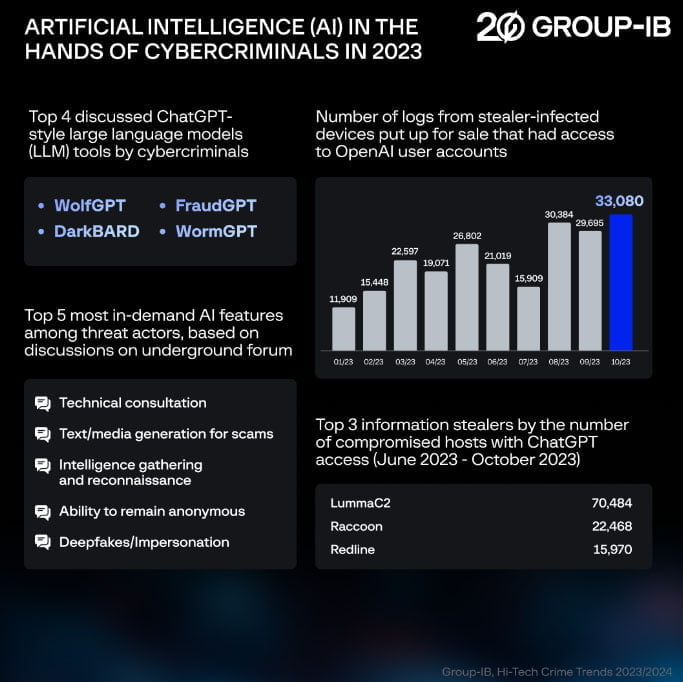
For the first time, Hi-Tech Crime Trends includes a section describing the complex relationship between artificial intelligence (AI) and cybersecurity threats, outlining how this new technology is being exploited by cybercriminals, including the misuse of large language models (LLMs) such as ChatGPT, as well as potential risks to company data through AI integration.
AI: no longer just an advantage
Threat actors have already shown how AI can help them develop malware with only limited programming knowledge, brainstorm new TTPs, compose convincing text for use in social engineering, and even boost their operational productivity.
Large language models (LLMs) such as ChatGPT continue to be widely used, and Group-IB analysts have observed continued interest on underground forums in jailbreaking ChatGPT and specialized generative pre-trained transformer (GPT) development, in order to find ways to bypass ChatGPT's safety controls.
Double trouble: ransomware and Initial Access Brokers
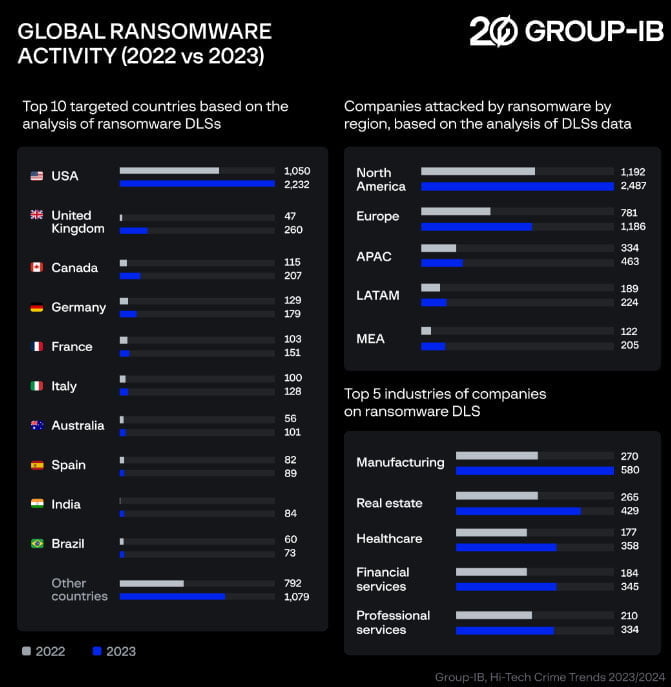
Group-IB's Threat Intelligence unit continuously monitors all ransomware activity and identified 4,583 companies that had their information, files and data posted on ransomware DLS during 2023. This marks a 74% increase compared to the previous year. Companies based in North America appeared most frequently in ransomware groups' DLS posts, accounting for 54% of the annual total.
APTitude test
Group-IB researchers found that the Asia-Pacific region was the world's leading battleground for nation-state-sponsored threat actors, also known as APT groups, last year. In total, Group-IB attributed 523 attacks to nation-state actors worldwide during 2023.
Turbulence ahead
In 2023, cyber threats shifted focus from Windows and Android to Apple platforms due to their growing popularity and market share, with iOS increasingly becoming a target. The group predicts that with Apple's expected allowance of third-party app stores, attacks will become more common.



