Forestry Machines Run on AI From Umeå
For the first time, researchers at Umeå University have developed an AI-controlled forestry machine. By training the AI in a simulated environment, they've managed to transfer control to a physical machine, marking a major success in autonomous technology for forestry.
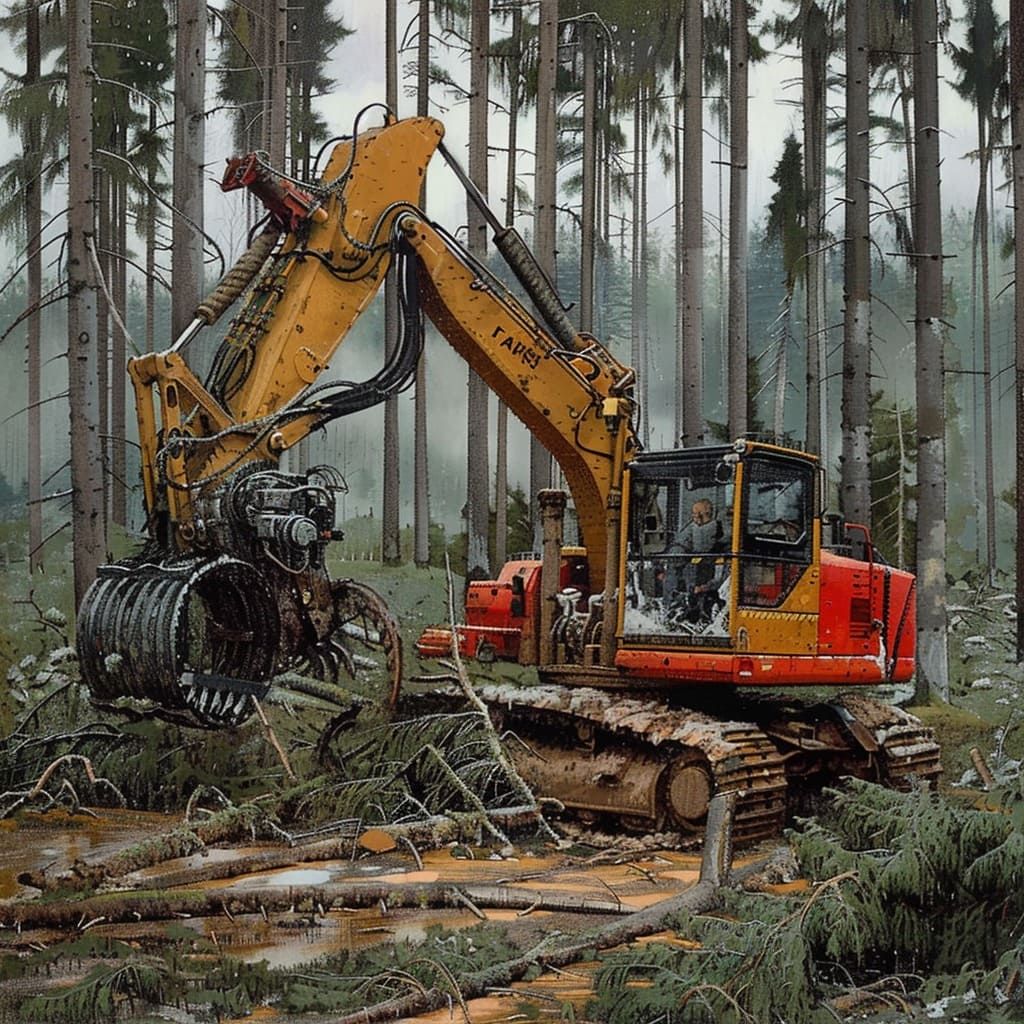
For the first time, researchers have succeeded in developing a self-driving forestry machine controlled by artificial intelligence. This milestone was reached in a research study at Umeå University, where an AI system was created to maneuver the 16-ton machine without human involvement. The study, carried out in collaboration with Skogforsk and Algoryx Simulation, demonstrates great potential for autonomous control of heavy machinery in forestry.
Challenges of AI-Controlled Heavy Machinery
AI control of heavy machinery requires large amounts of training data, which is both costly and risky. Traditionally, pretraining in simulated environments has been used to address this, but these simulations often fall short in matching reality. The research at Umeå University has shown that this obstacle can be overcome even for large, complex systems.
Successful Real-World Tests
At Skogforsk's test site in Jälla, outside Uppsala, the first successful tests were carried out. The AI was trained on Umeå University's supercomputer through several million training steps before taking over control of the forestry machine. During the tests, the AI successfully navigated various obstacles and followed a planned route.
Deep Reinforcement Learning Enables Autonomous Control
The technology used, deep reinforcement learning, has previously proven effective for controlling complex systems. Until now, however, its successes have been limited to digital systems or small, lightweight robots. Heavy machinery, such as that used in forestry, has complex mechanics that make it difficult to control.
Bridging the Reality Gap
A major obstacle has been the so-called "reality gap" – the difference between simulation and reality. Despite a high degree of realism in the simulations, there's always some discrepancy. The research at Umeå University has, however, shown that this gap can be bridged. The AI performed better with each attempt, demonstrating that the transition from simulation to real-world application is possible.
Publication and Recognition
The research findings have been published in scientific papers and were recently presented at the world congress of forest research, IUFRO, in Stockholm. This paves the way for future use of AI in forestry and other industries that rely on heavy machinery.
Sim-to-real transfer of active suspension control using deep reinforcement learning. Robotics and Autonomous Systems, 104731, doi.org/10.1016/j.robot.2024.104731 (2024).



