AI Use in Sweden in 2024
How are Swedes using AI? There are some interesting figures and big gaps between different age groups. We also share our take on why the technology isn't as established as it perhaps could have been by now.

The Internet Foundation (Internetstiftelsen) has released its report on AI use, and we've read it and summarized it. Artificial intelligence (AI) is becoming increasingly present in Swedes' everyday lives, especially among the young. According to the latest survey from the Internet Foundation, a third of the adult population has tried an AI tool in 2024. ChatGPT is the most popular tool, and the use cases for AI keep expanding, both in school and at work.
AI Use Has Leveled Off
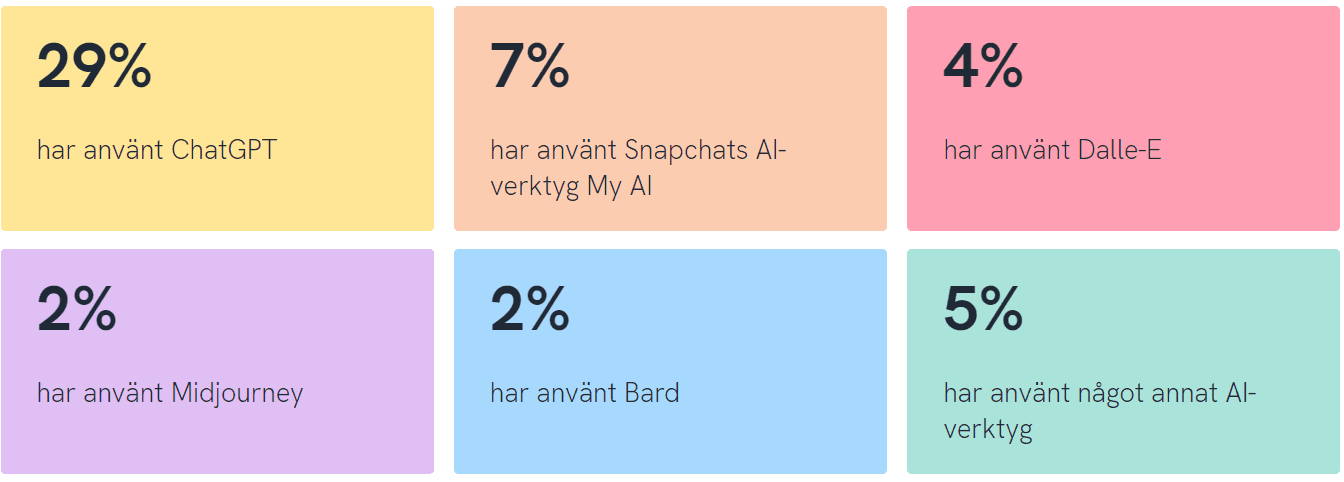
Despite the growing attention around AI, usage among Swedes hasn't changed much since 2023. A third of the adult population, aged 18-84, say they've used an AI tool in the past year. ChatGPT is the most-used tool, at 29% of respondents, while 7% have tried Snapchat's My AI, and smaller shares have used other tools like Midjourney (2%) and DALL-E (4%).
Some caution is advised when comparing across years, since Snapchat's My AI was included in the survey for the first time in 2024. Even so, overall use of AI tools hasn't increased significantly.
Persistent Gaps Between Young and Old
AI use varies sharply between age groups. Younger Swedes, aged 18-34, are leading the way, with six in ten having used an AI tool during the year. This stands in stark contrast to older age groups, especially people over 50, where the share of AI users is significantly lower.
Among teens, AI is even more widespread. A full 70% of young people aged 12-19 say they've used an AI tool, often for schoolwork. But teens don't use AI just for studying, they also use it for hobbies and interests, like looking up motivation tips or makeup advice.
AI at Work and in School
The use of AI tools continues to evolve in the workplace and in education. More adults are now using AI at work or in their studies compared to the previous year. In 2024, over 30% say they've used AI primarily at work, up from 20% the year before. Use in studies has also risen, from 8% to 15%.
AI is used at work for things like writing emails, creating meeting agendas, and even programming. Teachers use AI to assess students' levels by creating text-based tests or summarizing reports.
Skepticism Toward AI Among Older Swedes
Although many see benefits in AI, there's still widespread skepticism, especially among older Swedes. Nearly half of those aged 65 and older say they don't want to use AI in the future. The uncertainty isn't limited to older people, though; even a quarter of young adults aged 18-34 are unsure or negative about future AI use.
Swedes Are Open to AI in Public Transport and Healthcare
Despite some skepticism, many are open to AI playing a role in the society of the future. About 22% of Swedes could see themselves using self-driving public transport, while 14% are open to consulting an AI doctor for minor ailments. The least popular use case is AI companions on social media, with only 2% interested.
Challenges Keeping AI Technology From Becoming Established
Even though AI tools like ChatGPT have become increasingly common, there are still significant barriers to the technology becoming fully established. Many Swedes, especially older people, find AI difficult to understand and use in practice. One common problem is the learning curve - it takes time and knowledge to use AI tools effectively. Understanding how to phrase the right questions, so-called prompts, is a challenge for many, which can make the technology inaccessible to new users.
This difficulty in understanding and handling AI may partly explain why a large share of the population hasn't yet embraced the technology. AI is still associated with a certain amount of technical complexity, and cost, too, which can create a barrier for many who could otherwise benefit from it. For AI technology to become more accessible and user-friendly, more education and simpler interfaces are needed to help users navigate these tools.
The development of more intuitive AI tools and better guides for how to prompt could be the key to lowering the barriers and building broader acceptance of the technology in society.
Source: https://svenskarnaochinternet.se/utvalt/svenskarna-och-ai-2024/



